
How cyankiwi AWQ works
How our proprietary AWQ variant keeps 4-bit models faithful to the originals.
The Baseline: AWQ
When reducing LLM weights to low bit-widths, a small number of activation outliers carry a disproportionate amount of the model’s information. Only 0.1% to 1% of weight channels are “salient”, and they can be identified by looking at the activation magnitude.
The original Activation-aware Weight Quantization (AWQ) protects salient channels by scaling up before group-wise 4-bit rounding. Scales are chosen by a one-dimensional grid, and fit against a homogeneous English calibration set. Two limitations follow: the salience map is only as reliable as that calibration data, and the scaling search is decoupled from the clipping ranges that ultimately determine quantization error.
cyankiwi AWQ
cyankiwi AWQ improves on the baseline along two axes: calibration and optimization.
The calibration corpus is heterogeneous and cross-lingual, weighted toward the regimes where modern LLMs are actually stressed under deployment: technical reasoning and tool-using behavior. The diversity of the corpus is deliberate: it draws out the model’s full activation distribution rather than the narrow slice a small monolingual set would expose. Scales are then derived against activation statistics that reflect the model’s true operating range, producing a salience map aligned with how the model is actually used.
cyankiwi treats per-channel scales and quantization ranges as co-dependent variables rather than independent hyperparameters, fitting them together against a reconstruction objective. Scales are no longer chosen in isolation from the clipping that follows, and neither is fixed independently of the rounding it will undergo.
The Results
We benchmarked cyankiwi AWQ 26.05 update against every major 4-bit method on Llama-3 as examples, measuring KL Divergence vs the BF16 baseline on GPQA Diamond responses.
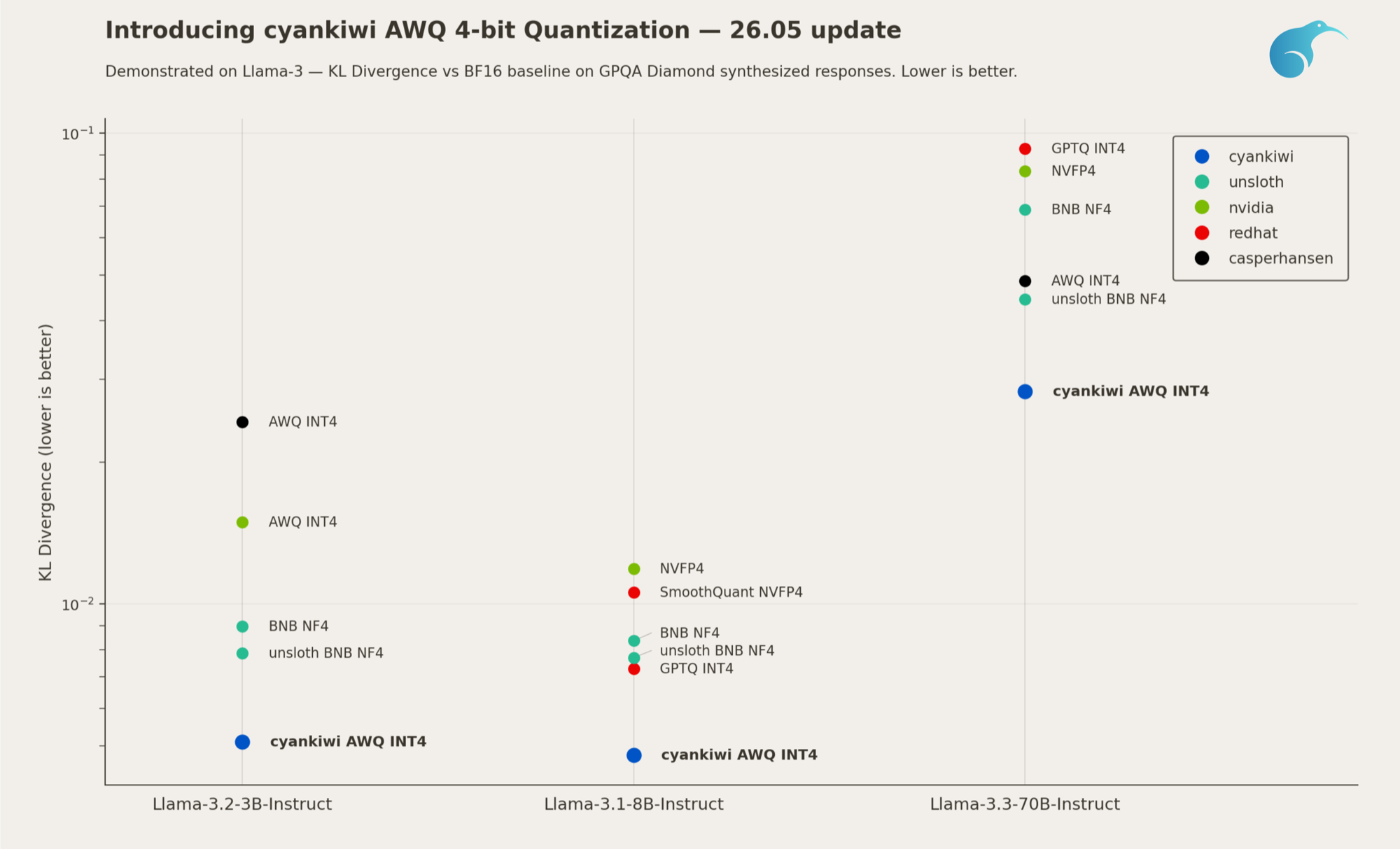
Result: cyankiwi posts the lowest KLD on all three base models. Lower is better.
Llama-3.2-3B-Instruct
| Quantized Model | Method | KLD |
|---|---|---|
| cyankiwi/Llama-3.2-3B-Instruct-AWQ-INT4 | cyankiwi AWQ INT4 | 0.00510 |
| unsloth/Llama-3.2-3B-Instruct-unsloth-bnb-4bit | unsloth BNB NF4 | 0.00785 |
| unsloth/Llama-3.2-3B-Instruct-bnb-4bit | BNB NF4 | 0.00896 |
| nvidia/Meta-Llama-3.2-3B-Instruct-ONNX-INT4 | AWQ INT4 | 0.01494 |
| casperhansen/llama-3.2-3b-instruct-awq | AWQ INT4 | 0.02437 |
Llama-3.1-8B-Instruct
| Quantized Model | Method | KLD |
|---|---|---|
| cyankiwi/Llama-3.1-8B-Instruct-AWQ-INT4 | cyankiwi AWQ INT4 | 0.00478 |
| RedHatAI/Meta-Llama-3.1-8B-Instruct-quantized.w4a16 | GPTQ INT4 | 0.00729 |
| unsloth/Meta-Llama-3.1-8B-Instruct-unsloth-bnb-4bit | unsloth BNB NF4 | 0.00769 |
| unsloth/Meta-Llama-3.1-8B-Instruct-bnb-4bit | BNB NF4 | 0.00835 |
| RedHatAI/Llama-3.1-8B-Instruct-NVFP4 | SmoothQuant NVFP4 | 0.01059 |
| nvidia/Llama-3.1-8B-Instruct-NVFP4 | NVFP4 | 0.01190 |
| amd/Llama-3.1-8B-Instruct-awq-asym-uint4-g128-lmhead-onnx-hybrid | AWQ INT4 | 0.10161 |
Llama-3.3-70B-Instruct
| Quantized Model | Method | KLD |
|---|---|---|
| cyankiwi/Llama-3.3-70B-Instruct-AWQ-INT4 | cyankiwi AWQ INT4 | 0.02826 |
| unsloth/Llama-3.3-70B-Instruct-unsloth-bnb-4bit | unsloth BNB NF4 | 0.04444 |
| casperhansen/llama-3.3-70b-instruct-awq | AWQ INT4 | 0.04859 |
| unsloth/Llama-3.3-70B-Instruct-bnb-4bit | BNB NF4 | 0.06879 |
| nvidia/Llama-3.3-70B-Instruct-NVFP4 | NVFP4 | 0.08307 |
| RedHatAI/Llama-3.3-70B-Instruct-quantized.w4a16 | GPTQ INT4 | 0.09272 |
Acknowledgment
We are grateful to:
- MIT Han Lab for the original AWQ research
- Casper Hansen for the reference AWQ implementation
- The vLLM and Red Hat AI teams for the production tooling we build on